Executive Operating Review
Business Reviews that run themselves
Rhythms AI generates the brief, tracks every commitment, and keeps updates current, so the review does the work it was supposed to.
Trusted by operating teams at






Same review, different names, same problem
Someone has to assemble it manually every time, no matter what you call it. Rhythms runs itself either way.
Integrations
Stop copying and pasting into docs and decks
Connect your existing tools and Rhythms AI reads across all of them before every review cycle.









The problem
Business reviews fail in the 48 hours before and the two weeks after, not in the room.
Every session starts from zero.
The brief takes half a day to build. Chasing updates, waiting on replies, stitching it together the night before.
The meeting becomes a status readout.
No record of last time’s commitments. Decisions get squeezed into the final minutes.
Commitments leave the room and disappear.
No one owns them. They resurface only when the quarter is already at risk.
How it works
An operating loop that compounds. Not a report. Not another notetaker.
Set it up once. Rhythms AI runs before every review, sharper each time.
The pre-read brief
One brief. Only what matters. In your inbox before the meeting starts.
Rhythms AI reads across your tools before each review and surfaces only what’s moving, at risk, or needs a decision, delivered before the meeting starts.

The pre-read brief
One brief. Only what matters. In your inbox before the meeting starts.
Rhythms AI reads across your tools before each review and surfaces only what’s moving, at risk, or needs a decision, delivered before the meeting starts.
The pre-read brief
One brief. Only what matters. In your inbox before the meeting starts.
Rhythms AI reads across your tools before each review and surfaces only what’s moving, at risk, or needs a decision, delivered before the meeting starts.
The review hub
A slipped date never quietly disappears.
The Review Hub refreshes daily, with risks, commitments, and overdue follow-ups carried forward automatically. Nothing falls through the cracks because the system holds it, not a person.
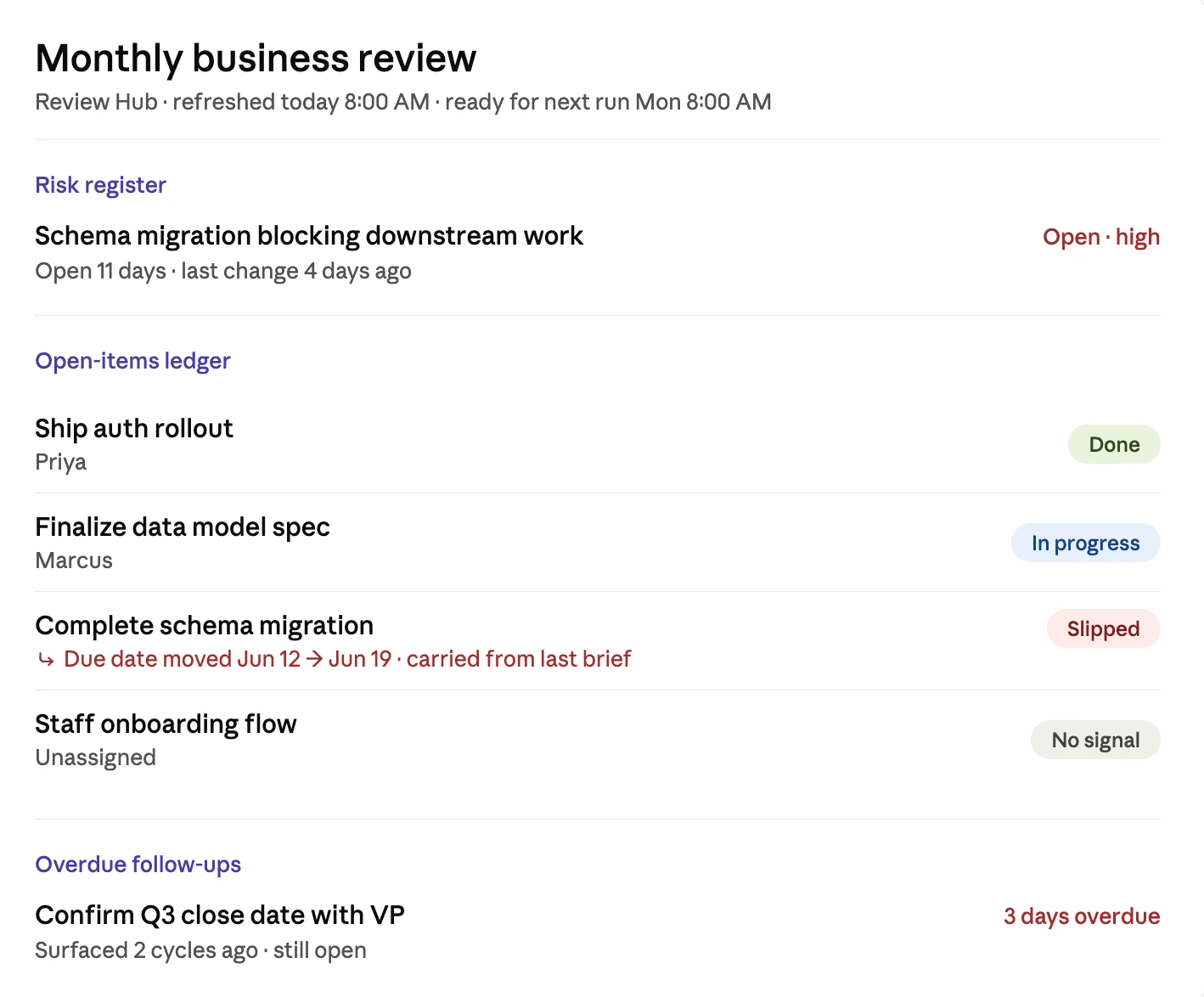
The review hub
A slipped date never quietly disappears.
The Review Hub refreshes daily, with risks, commitments, and overdue follow-ups carried forward automatically. Nothing falls through the cracks because the system holds it, not a person.
The review hub
A slipped date never quietly disappears.
The Review Hub refreshes daily, with risks, commitments, and overdue follow-ups carried forward automatically. Nothing falls through the cracks because the system holds it, not a person.
Runs itself, every cycle
Runs on schedule. Remembers everything. Gets sharper each time.
No trigger needed. The more cycles Rhythms AI runs, the more context it carries, so each review is sharper than the one before it.

Runs itself, every cycle
Runs on schedule. Remembers everything. Gets sharper each time.
No trigger needed. The more cycles Rhythms AI runs, the more context it carries, so each review is sharper than the one before it.
Runs itself, every cycle
Runs on schedule. Remembers everything. Gets sharper each time.
No trigger needed. The more cycles Rhythms AI runs, the more context it carries, so each review is sharper than the one before it.
What our customers say
“
Rhythms’ AI engine keeps our team focused on executing priorities. Onboarding was more of a partnership than an implementation.
Founding Partner & COO
“
I used Chat to pull our Key Result metrics and build a month-by-month composite network health score, documented, defensible, and reused for every assessment since.
Sr. Director, Infrastructure Operations
Related Resources

Blog
What Is an Executive Operating Review, and Is Yours Actually One?
Most leadership teams think they run an executive operating review. Here’s how to tell if yours is.
Read more→
Blog
The Executive Operating Review Template That Actually Drives Decisions
Most operating review templates are just recaps. Here’s the four-section one I actually use.
Read more→
Blog
The Best Executive Operating Review Software in 2026
Most “best operating review software” lists rank the wrong tools. An operator’s honest guide.
Read more→Blog
What Is an Executive Operating Review, and Is Yours Actually One?
Most leadership teams think they run an executive operating review. Here’s how to tell if yours is.
Read more→Blog
The Executive Operating Review Template That Actually Drives Decisions
Most operating review templates are just recaps. Here’s the four-section one I actually use.
Read more→Blog
The Best Executive Operating Review Software in 2026
Most “best operating review software” lists rank the wrong tools. An operator’s honest guide.
Read more→FAQs
Rhythms generates two things: a Briefing and a Review Hub. The Briefing is delivered before each review. It reads across your connected tools, surfaces only what’s moving, at risk, or needs a decision, and includes a 3-minute summary your team can read without opening anything else. The Review Hub is a living record that carries forward open items, slipped dates, and unresolved commitments across every cycle, refreshed daily, with no one maintaining it manually.
When a commitment is made in a review, Rhythms logs it to the Review Hub with an owner and date. Before the next review, it checks for movement across your connected tools. If nothing has changed, it flags it as stuck. If a date slips, it carries the note forward. Nothing falls through because no human has to remember to follow up.
No. Setup takes under a day and requires no technical configuration. You connect your existing tools, tell Rhythms what you want to review, and it runs from there. The first Briefing is ready before your next scheduled review.
Yes. You control what Rhythms pays attention to: which initiatives, which teams, which signals matter. You also approve the Briefing before it goes to the wider team, so nothing goes out that doesn’t reflect your judgment.
Notes capture what was said. Rhythms tracks what was committed to, and whether it happened. Notes don’t read your systems before the next meeting. They don’t flag a slipped date or surface a risk that went quiet. Rhythms runs before and after every review, so the meeting itself can focus on decisions instead of status.
You can log it directly in the Review Hub. Once it’s there, Rhythms tracks it forward the same way, flagging it if there’s no movement and surfacing it before the next review. The Hub is the source of truth, not the tool.
Stop prepping. Start running reviews that stick.
Set it up in a day. Walk into your next review with a brief that’s already done and leave knowing every commitment is tracked.
Stop prepping. Start running reviews that stick.
Set it up in a day. Walk into your next review with a brief that’s already done and leave knowing every commitment is tracked.
Solutions
Reviews
© Copyright 2026. All Rights Reserved.
Solutions
Reviews
© Copyright 2026. All Rights Reserved.
Solutions
Reviews
© Copyright 2026. All Rights Reserved.