From the team that built Ally.io and led Viva Goals at Microsoft
Your status report. Ready before the review. Automatically.
RAG status, RAID items, and critical path risks pulled from every team’s tools and synced into a report before the meeting. No chasing. No manual brief.
Trusted by operating teams at








Sound familiar?
The status is always green. The surprises are always late.
If this is your week, the problem isn’t your team. It’s that nothing is watching the space between what’s reported and what’s real.
Risk, surfaced too late
“Which RAID dependency is quietly blocking another team’s critical path right now?”
Reported ≠ reality
“Every dashboard says green, but the launch date keeps quietly slipping.”
False green
“Last review said ‘on track.’ Nobody flagged the vendor delay until the sprint after.”
Risk, surfaced too late
“Which RAID dependency is quietly blocking another team’s critical path right now?”
Reported ≠ reality
“Every dashboard says green, but the launch date keeps quietly slipping.”
False green
“Last review said ‘on track.’ Nobody flagged the vendor delay until the sprint after.”
How it works
Rhythms AI builds the brief. You run the review.
Rhythms connects to every team tool, generates the structured pre-read, and carries every action item forward, automatically, before every cycle.
The pre-read brief
One brief. Every RAG, RAID item, and risk named before you walk in.
Connects to Jira, Linear, GitHub, Asana, and every tool your teams use. Delivers a structured pre-read before each review: RAG status by workstream, open RAID items, critical path risks, and the decisions waiting on you.
Inter-workstream dependency analysis
Rhythms finds the blockers your project tools can’t surface.
Jira and Linear track tasks in isolation. Rhythms reads across all of them (engineering, design, product, ops), maps the dependency chain, and flags each RAID blocker with its owner and escalation path.
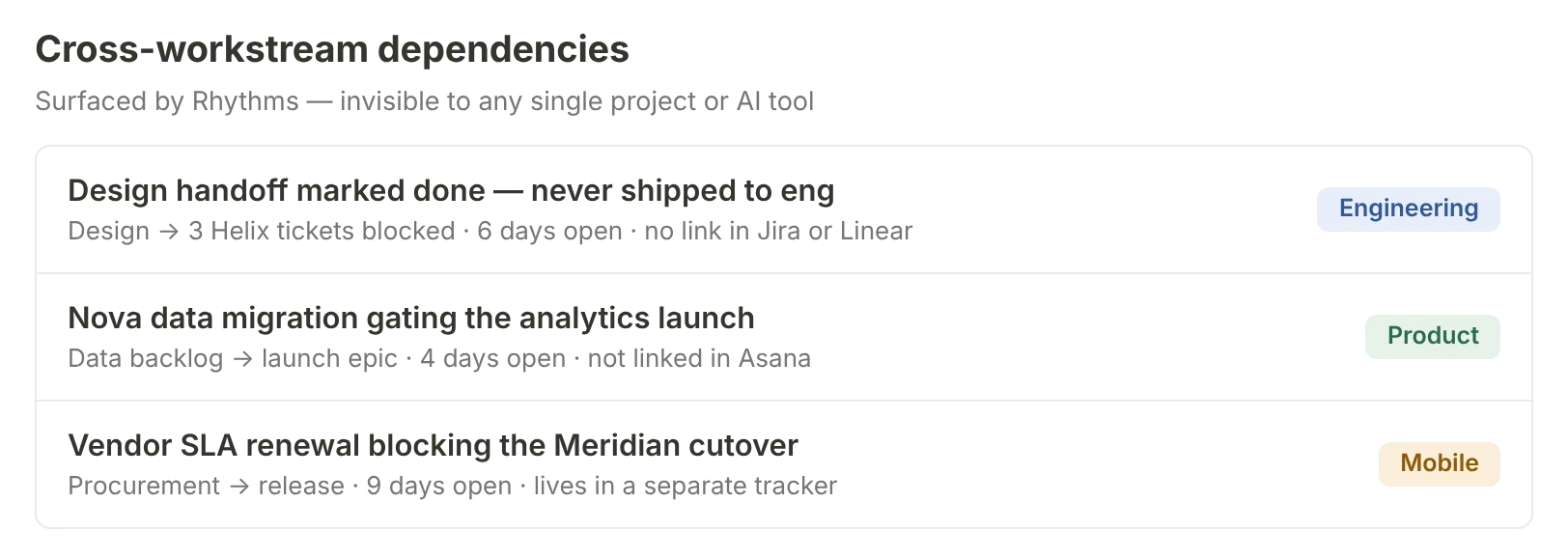
Inter-workstream dependency analysis
Rhythms finds the blockers your project tools can’t surface.
Jira and Linear track tasks in isolation. Rhythms reads across all of them (engineering, design, product, ops), maps the dependency chain, and flags each RAID blocker with its owner and escalation path.
Governance model and decision log
Set it once. Runs before every review. Remembers everything.
Runs on your governance cadence, weekly, bi-weekly, or monthly. Every decision is logged and carried forward automatically, with status pulled from your connected tools. No manual RAID updates.

Governance model and decision log
Set it once. Runs before every review. Remembers everything.
Runs on your governance cadence, weekly, bi-weekly, or monthly. Every decision is logged and carried forward automatically, with status pulled from your connected tools. No manual RAID updates.
Governance model and decision log
Set it once. Runs before every review. Remembers everything.
Runs on your governance cadence, weekly, bi-weekly, or monthly. Every decision is logged and carried forward automatically, with status pulled from your connected tools. No manual RAID updates.
What changes
What changes when PMO teams use Rhythms?
Rhythms doesn’t just report status. It catches drift early, cuts meeting time, and makes sure nothing tracked gets dropped.
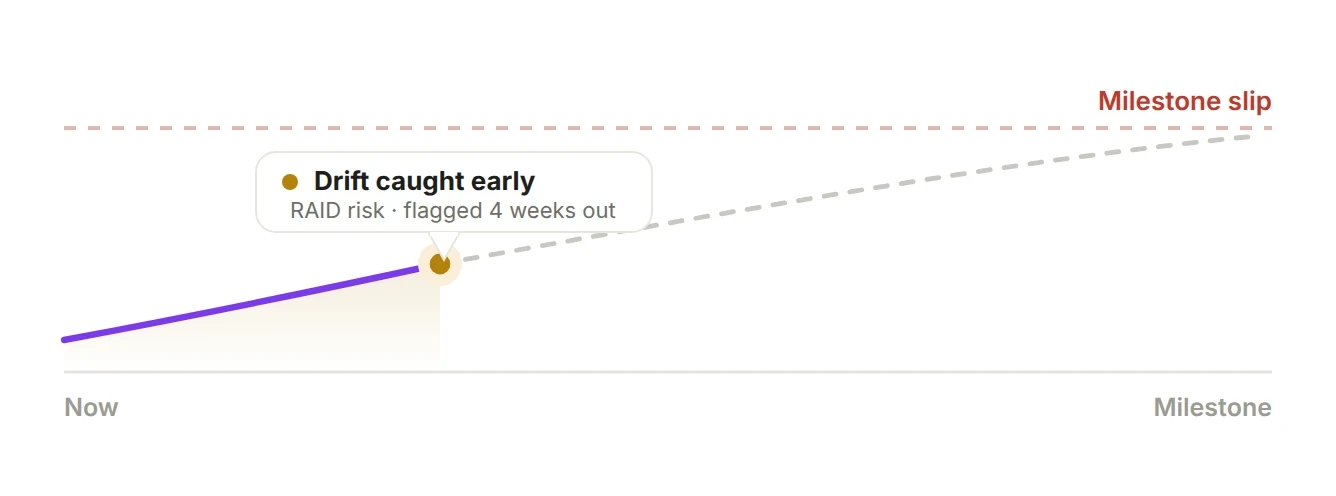
Catch risk before it becomes a milestone slip
Rhythms catches execution drift and RAID risks weeks out, while they’re still cheap to fix.
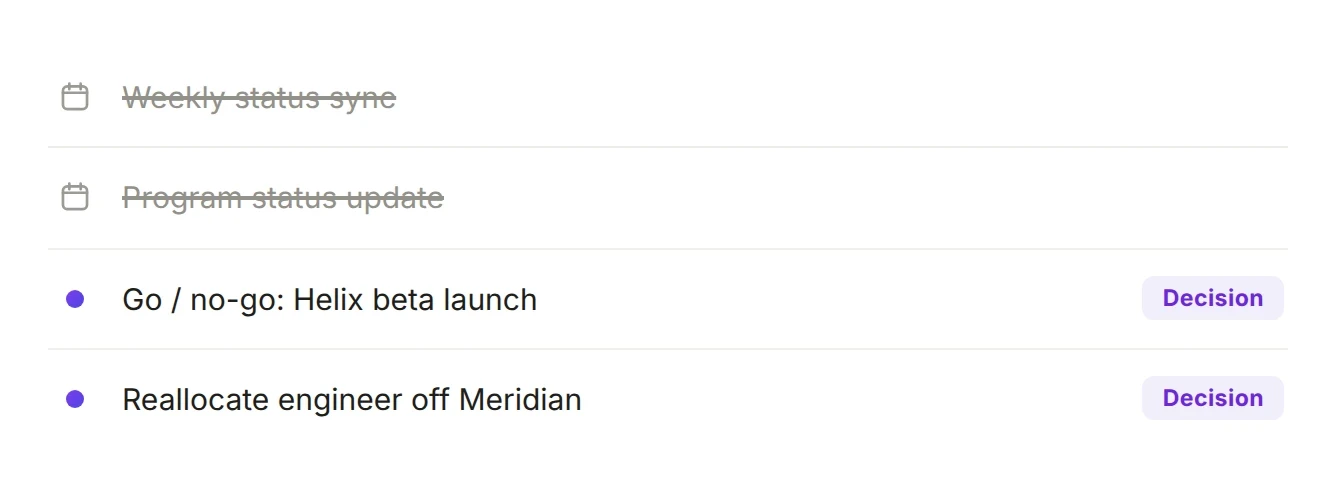
Fewer status meetings, faster decisions
Teams walk in already briefed, so the review is spent deciding, not chasing status or rebuilding context.
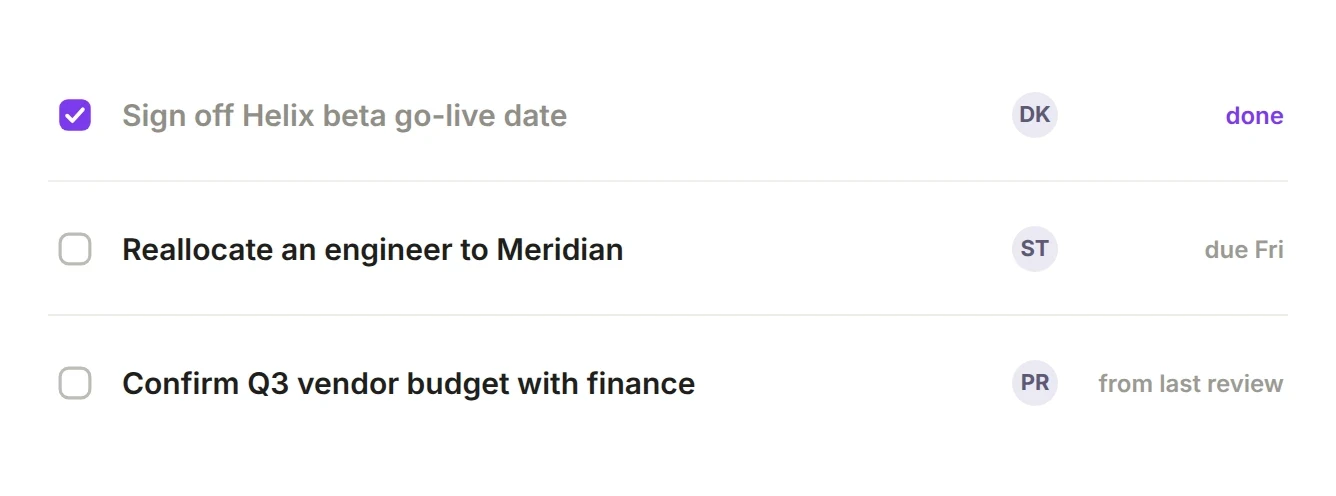
Every commitment tracked forward
Every decision and action item is logged and owned, with no separate tracker and no dropped commitments.
Catch risk before it becomes a milestone slip
Rhythms catches execution drift and RAID risks weeks out, while they’re still cheap to fix.
Fewer status meetings, faster decisions
Teams walk in already briefed, so the review is spent deciding, not chasing status or rebuilding context.
Every commitment tracked forward
Every decision and action item is logged and owned, with no separate tracker and no dropped commitments.
8+
hours saved per review cycle on status chasing and brief prep
100%
of commitments tracked forward automatically, no separate tracker
<1 day
to connect your tools and get your first automated pre-read
What our customers say
“
Rhythms’ AI engine keeps our team focused on executing priorities. Onboarding was more of a partnership than an implementation.
Founding Partner & COO
“
I used Chat to pull our Key Result metrics and build a month-by-month composite network health score, documented, defensible, and reused for every assessment since.
Sr. Director, Infrastructure Operations
FAQs
Claude and Copilot require you to gather data, paste it in, and prompt them every cycle. Rhythms connects directly to your tools, pulls live data before each review, and maintains persistent memory of decisions and commitments across cycles, with no prompting required.
Jira, Linear, GitHub, Asana, Shortcut, Monday.com, Notion, Confluence, Slack, Google Sheets, ClickUp, and more. Standard OAuth, so no engineering work and no API keys.
No. Rhythms delivers the pre-read before your review and captures commitments after. Your cadence, attendees, and agenda stay unchanged. Your team just walks in already briefed.
Most teams are live within one business day. Authenticate via OAuth, configure which projects to include, set your cadence, and Rhythms handles the rest.
For items not tracked in a connected system, team leads can submit their section’s status directly into Rhythms. Commitments are still tracked forward automatically, and the consolidated pre-read includes both connected and manually sourced data.
After each review, decisions and commitments are captured via a structured form or pasted meeting notes, each linked to an owner and date. Before the next cycle, Rhythms checks your tools for status and carries open items forward automatically. No separate tracker required.
Stop chasing updates. Run reviews that drive outcomes.
Set it up once. Walk into your next weekly review with a status brief that’s already done and leave knowing every risk is tracked.
Stop chasing updates. Run reviews that drive outcomes.
Set it up once. Walk into your next weekly review with a status brief that’s already done and leave knowing every risk is tracked.
Solutions
Reviews
© Copyright 2026. All Rights Reserved.
Solutions
Reviews
© Copyright 2026. All Rights Reserved.
Solutions
Reviews
© Copyright 2026. All Rights Reserved.